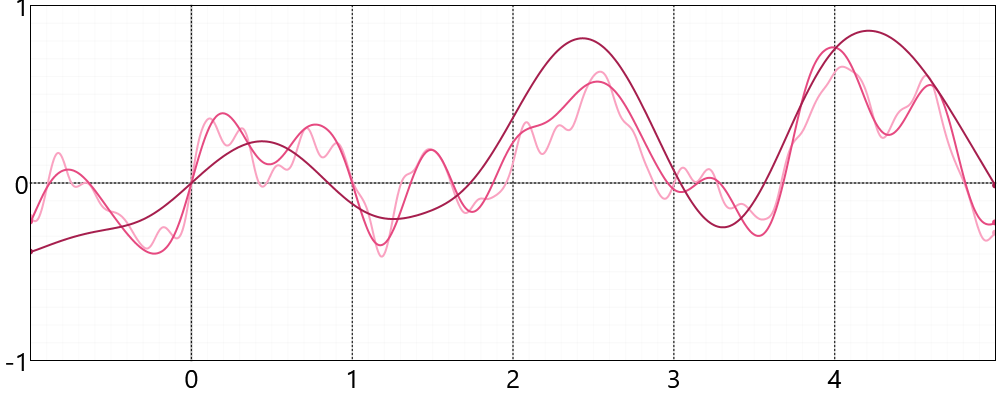
The standard gradient noise function in Grasshopper 2.0. It is based on layering multiple simple noise functions, otherwise known as octaves, with each octave having both a higher frequency and a lower amplitude than the previous one. S-Noise is very similar to the more commonly used Simplex and Perlin noise functions, but allows for partial octaves, and is always guaranteed to yield zero when x=0.
The S-Noise graph in the function editor is controlled by two grips and three sliders. The grips control the location and the dimensions of the graph, while the sliders control its shape. The seed slider allows one to smoothly vary the pattern of peaks and valleys. The octave slider specifies the number of layered noise functions, and the decay slider controls how much weaker every new layer is.